
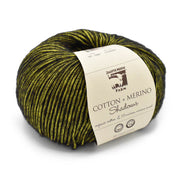
♡ Cotton + Merino
$21.95 · 229 yards per skein
70% Organic Cotton, 30% Merino Wool
Needles: 4.5–5.5 mm · Care: Hand Wash, Lay Flat to Dry
Hooks: 4.5–5.5 mm
No gatekeeping. No assigned scarf you don’t even like. Just a friendly way to figure out what you want to make and what you actually need.
Open the full yarn calculator →
A few yarns to explore for your project. Match your pattern’s yarn weight, yardage, and gauge before choosing your supplies.
$21.95 · 229 yards per skein
70% Organic Cotton, 30% Merino Wool
Needles: 4.5–5.5 mm · Care: Hand Wash, Lay Flat to Dry
Hooks: 4.5–5.5 mm
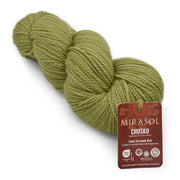
$17.95 · 273 yards per skein
100% Corriedale Wool
Needles: 3.75–4.5 mm · Care: Hand Wash, Cold Water, Lay Flat to Dry, Do Not Tumble Dry, Do Not Bleach
Hooks: 3.75–4.5 mm
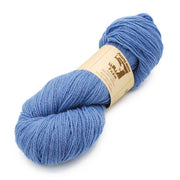
$16.95 · 382 yards per skein
100% Organic Merino Wool
Needles: 3.75–4.5 mm · Care: Hand Wash, Lay Flat to Dry, Do Not Tumble Dry, Do Not Bleach
Hooks: 3.75–4.5 mm
Search the exact weird little word or abbreviation your pattern just threw at you. You only need to learn it when you need it.
Search a word or abbreviation. Read the definition now; learn the technique when your project calls for it.
Pull a new loop through an existing stitch. It forms a V on one side and a bump on the other. Practice a row slowly, keeping the yarn behind the needles.
The companion to knit: work with yarn in front. The bump faces you. Knits and purls are the foundation of most knitted textures.
Worked flat: knit every row. Worked in the round: alternate a knit round and a purl round. It makes horizontal ridges and usually lies flat.
Worked flat: alternate knit and purl rows. In the round: knit every round. The front shows Vs; the edges naturally curl. Curling does not mean you failed.
Alternate knit and purl columns. 3×1 means three knit stitches, then one purl stitch. On later rows, work the stitches as they appear; follow the pattern for edge stitches and stitch-count multiples.
Alternating knits and purls make small bumps. Seed and moss names vary by region, so follow the actual row instructions rather than the name alone.
Create the starting stitches on your needle. A cast on begins knitting; it is different from casting off.
A useful everyday cast on made with the working strand and a reserved tail. The tail must be long enough for all starting stitches. Use the linked tutorial to see the hand movement.
Make starting stitches using needles. A knitted cast on is approachable; a cable cast on makes a firmer edge and can add stitches during a project. Use whichever the pattern specifies.
A temporary beginning that lets you recover live stitches later. Used for joining or knitting in the opposite direction. Save this for a pattern that requests it.
A polished, stretchy beginning for compatible ribbing. Setup depends on the rib pattern. It is useful later, but unnecessary for your first practice square.
Two names for closing the live stitches at the end. Cast on starts the piece; bind off finishes it.
Work two stitches, lift the earlier stitch over the newer one and off the needle; work one more and repeat. Keep the edge relaxed. Finish the last loop with the yarn tail.
Different finishes suit different edges. A stretchy method can help cuffs; a sewn or tubular finish can suit ribbing. Match the method to your pattern and test its stretch.
Add stitches to make fabric wider or shape it. An increase changes stitch count; short rows add local height without necessarily adding stitches.
Lift the strand between stitches and work it twisted so it does not leave a hole. Left and right versions lean in different directions; see the linked tutorial.
Knit into the front and then the back of the same stitch before dropping it. One stitch becomes two, often leaving a small visible bump.
Bring yarn over the needle to create an extra loop. It typically adds a stitch and a deliberate hole; lace patterns often pair it with a decrease.
Reduce stitch count to narrow or shape fabric. A sleeve, crown of a hat, or toy may use decreases.
Knit two stitches together as one. In standard Western stitch orientation, this is a right-leaning decrease.
A common left-leaning decrease. Slip two stitches as directed, then knit them together through the back. Follow the pattern or tutorial for the slipping method.
Turn before reaching the end of a row and work back. Extra partial rows add height to part of the fabric, useful at a back neckline, shoulder, heel, or shaped hem.
A short-row method that uses a double stitch at the turn to control the gap. Work both legs together as one stitch when you reach it again. The double stitch still counts as ONE. Do not swap from wrap-and-turn instructions without checking the turning position.
Move a group of stitches in front of or behind another group before working them. This rearrangement makes the crossing. Fabric may pull in; swatch the actual cable pattern.
A plush structure using slipped stitches and yarn overs worked together. It has its own notation and tension habits. Learn ordinary ribbing first.
An adjustable starting loop. In crochet, the loop on the hook is not a completed stitch; in knitting, whether the slip knot counts depends on the cast-on method.
Yarn over and pull through the loop on your hook. Repeated chains often form the starting edge. Keep them relaxed so you can work into them.
Insert hook, yarn over and pull up a loop, yarn over and pull through both loops. This makes a short, compact stitch.
Yarn over first, insert hook and pull up a loop, then yarn over and pull through all three loops. Taller than single crochet.
Yarn over, insert hook and pull up a loop; yarn over and pull through two loops, then yarn over and pull through the remaining two. Taller and often more open than single crochet.
Yarn over twice before inserting the hook; after pulling up a loop, work through two loops at a time three times. This creates a tall stitch.
Insert hook, yarn over, and pull through the stitch and the loop on the hook in one movement. Used for joining, travel, or a low edge.
Chains at a row’s start bring the hook up to the next row’s height. The number and whether they count as a stitch depend on the pattern. Mark the first and last real stitches.
A common increase works two stitches into the same stitch. Some patterns use a different number or a chain-space increase; follow its instructions.
Combine two stitches into one by completing them together. The exact steps depend on stitch type. An invisible single-crochet decrease is common in toys.
Cut a generous tail, pull it through the final loop to secure it, then weave it in. Crochet usually fastens off rather than binding off a whole row of live stitches.
An adjustable loop for working the first round into a closeable center. Secure the tail carefully. You can learn this when you are ready for a round project.
A small repeatable unit, often worked in rounds, that can be joined into a larger project. Motif designs vary; not every square uses the classic granny stitch.
Check this before starting: US single crochet = UK double crochet; US half double = UK half treble; US double = UK treble; US treble = UK double treble. The same abbreviation can mean a different stitch.
Uses a forward pass that collects loops and a return pass that works them off, often with a longer hook. It is its own technique rather than ordinary crochet with a new name.
How many stitches and rows fit a measured area in the specified stitch pattern. Your tool size is a starting point; your measured fabric determines fit.
A sample in your project’s yarn and stitch. Make it larger than the area you measure, wash and dry as the finished piece will be cared for, then measure the middle.
Too many means smaller stitches: try a larger tool. Too few means larger stitches: try a smaller tool. Swatch again; changing stitch pattern or yarn can change the result.
Finished garment size minus body measurement. Positive ease adds room; negative ease makes a closer fit. Use the pattern’s intended fit and finished measurements.
The intended outside and inside of the fabric. Some textures are reversible. Mark the right side if you have trouble telling them apart.
Flat work goes back and forth, usually with turns. In the round, work around a tube or circle. Stitch-pattern instructions can change between these methods.
Two needle tips joined by a cable. They can work flat pieces as well as tubes. The cable length and technique must suit the project circumference.
Place marker / slip marker. Knitters often use a closed ring between stitches; crocheters often use a locking marker in a stitch. A marker is not itself a stitch.
Repeat the specified group, not the whole row unless told to. Read the pattern’s notation key; parentheses may also hold size-specific instructions.
The production batch of a dyed yarn. Matching lots helps reduce unexpected shade differences. For hand-dyed yarn, alternate skeins if recommended.
Work two strands as one. Each strand needs the project’s working length: 500 yards held double needs about 500 yards of each strand, not 250 of each.
Ways of using multiple colors. Stranded work carries unused yarn behind; intarsia uses separate yarn sections for blocks. Stripes change colors between sections.
Shape the finished fabric after washing or another fiber-appropriate method. Follow the yarn care label, lay to measurements, and avoid pulling it beyond the intended size.
Thread tails into the fabric with a tapestry needle so they remain secure. Choose a route that suits the stitch and fiber; trim only after checking security.
Pause and count. Knitting can accidentally make yarn overs or lose live loops; crochet can accidentally skip an edge or work into a turning chain. Compare the last correct row before undoing.
Frog means unravel; tink means undo knitting one stitch at a time. A lifeline is waste yarn through a correct row of live stitches, providing a place to return to.
Yarn weight means thickness/category, not how heavy the ball is. Grams describe package mass; yards or meters describe length. Two 100 g balls can hold very different lengths.
Ply is strand count and does not universally determine thickness. Firmly twisted yarn often shows stitches clearly; brushed, blown, chainette, and loosely spun yarns behave differently.
Fiber is the material, such as wool or cotton. Brand is the company. Two yarns from one brand can have very different stretch, care, texture, and uses.
No matching term yet. Try a shorter word, or bring the wording to Mary.